
· updated
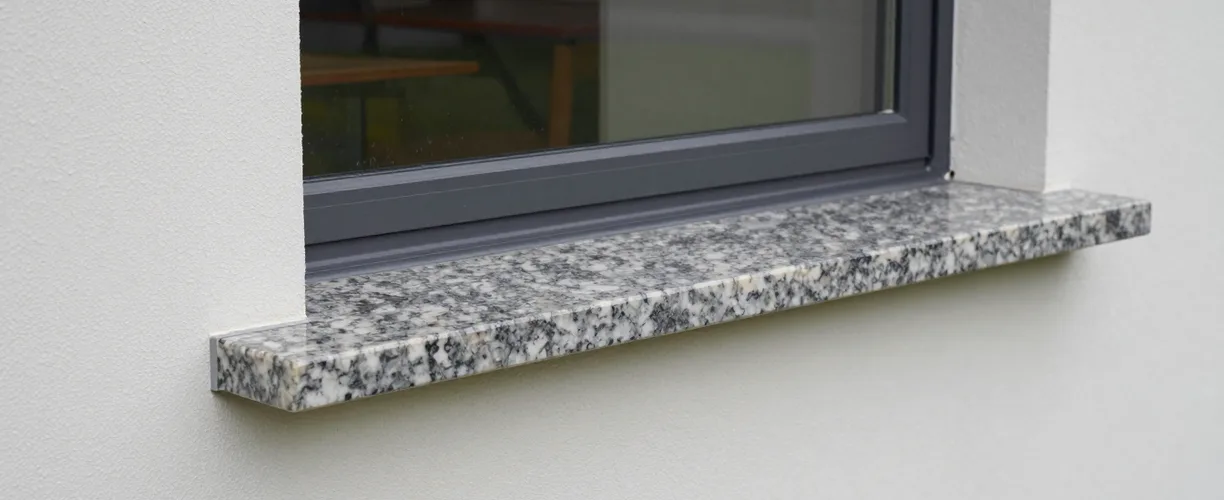
In short: use granite outside; inside, granite and marble both work well. Marble is a calcareous stone, sensitive to acids, and outdoors it loses its polish over time; granite is much denser and withstands rain and frost. A good exterior sill has three more things: it overhangs the face of the wall by at least 3 cm, it has a groove underneath called a drip groove, and it is fitted with a slope towards the outside. The usual thicknesses are 2 and 3 cm. A ready-cut sill from a DIY store works when your window matches one of its fixed sizes; for windows of different sizes, an insulated facade or a particular colour, the sill is cut to order.
In this article
The sill is the horizontal slab under the window. Inside, it is mostly a surface you see and use every day. Outside, it has an extra job: it takes the rainwater running down the glass and throws it clear of the wall.
When an exterior sill fails at this, the marks show up under the window: dirt streaks on the facade, plaster that swells and flakes, damp in the wall. These are the typical effects of a sill without a drip groove. That is why, outside, what matters is not only the stone but also how it is cut and fitted.
Granite. The sources we read agree on this, and the reason lies in the nature of the stone.
That does not make marble a poor choice. Inside, where there is no rain or frost, a white or cream marble sill brightens a window like few materials can. The condition is the same as for any marble: no acidic cleaners (vinegar, lemon, limescale remover) and a proper sealer, because acids eat its polish. We wrote more about this in our article on caring for natural stone.
| What you care about | Granite | Marble |
|---|---|---|
| Exterior sill (rain, frost, sun) | suitable — dense, frost-resistant rock | not recommended — loses polish, sensitive to acids and frost |
| Interior sill | suitable, very resistant to scratches and stains | suitable, bright look; keep acidic products away |
| Polish over time | stays | stays indoors with care; turns dull outdoors |
| Contact with vinegar, lemon, limescale remover | resists well | stains and dulls |
| Usual thicknesses | 2 cm or 3 cm | 2 cm or 3 cm |
If you want the same stone inside and out, so the windows look the same from both sides, granite is the only option that covers both without compromise.
Width starts from the thickness of the wall. For an exterior sill you add the overhang beyond the wall: in practice 3 to 5 cm, never less than 3 cm. Interior sills usually get an extra 1–2 cm beyond the plaster.
If the facade is going to be insulated, the 3 cm are measured from the finished face of the wall, after the insulation and render, not from the brick. A sill measured before insulation ends up flush with the wall afterwards — and the drip groove can no longer do its job.
Thickness is usually 2 or 3 cm; the slabs we stock for sills come in these thicknesses. The thicker option matters outside: the drip groove is a cut in the stone, and a clean, durable groove needs at least 2–3 cm of stone.
A ready-cut sill from the store is fine when your window has exactly one of its sizes; otherwise, a sill cut to order saves you cutting and adjusting on site. DIY stores sell ready-cut granite sills in fixed lengths and widths and in a small number of colours. A sill cut to order is fabricated from the slab you choose, to the millimetre, for each window.
The difference shows in three things. First, length: windows in the same house rarely have the same width, and a standard piece that is too long has to be shortened on site with a cutting disc. Second, exterior width: after insulation, the wall grows by the thickness of the insulation and render, and the sill still has to overhang the finished face by at least 3 cm — a width that is often not on the shelf. Third, colour match: granite is a natural stone and slabs differ from one another; sills cut from the same slabs look the same across the whole facade.
| What you care about | Ready-cut sill from a store | Sill cut to order |
|---|---|---|
| Length and width | a few fixed sizes | exactly what each window needs |
| Insulated facade | the right width may be missing | measured from the finished face of the wall |
| Thickness | whatever is on the shelf | 2 or 3 cm, depending on where it goes |
| Drip groove | check whether it has one and how far from the edge it is cut | cut during fabrication, in the right place |
| Colours | a few options | over 50 stones suitable for sills, in stock |
| Same shade on every window | depends on the batch on the shelf | cut from the same slabs |
If you have one or two interior windows in a size you can find on the shelf, a store-bought sill is a good solution. For a whole house, especially outside, a sill cut to order spares you cuts on site and shades that do not match. We cut granite and marble sills to size — send us your measurements with the "Request a quote" button below.
We have over 50 stones in stock suitable for sills, granite and marble; the colour is chosen to suit the facade and the window frames. Here are the granites suitable for sills, grouped by the colours most people look for:
You can see all of them, with photos, on the home & construction page, filtered by "Window sills". If you are not sure which colour suits your house, send us a photo of the facade and the window frames, or come to the yard in Cazasu to hold the slab up against the window.
The drip groove is a thin channel cut along the whole length of the sill, on its underside, in the part that sticks out from the wall. Water reaching the edge of the sill can no longer creep underneath to the wall: it collects at the groove, forms drops and falls. The principle is old — it appears in stone cornices and sills as far back as Roman buildings.
Where exactly is it cut? In practice, about 1 cm from the outer edge, while installation guides require the groove to be at least 3 cm from the wall. Together they say the same thing: a sill that sticks out only 2 cm has no room for a useful drip groove. That is why the minimum 3 cm overhang and the drip groove go together.
The drip groove has to be ordered, because it is cut when the stone is fabricated, not on site. Mention it explicitly when you ask for a quote for exterior sills.
An exterior sill is never fitted perfectly level. A flat sill holds water, and the water ends up in the joint next to the window and in the wall.
On how steep the slope should be, sources differ. The German installation guide gives a rule of thumb of roughly 1 cm drop for every 10 cm of width: 1.5 cm on a 15 cm sill, 2 cm on a 20 cm sill, 3 cm on a 30 cm sill. Other guides use smaller slopes. What never changes is the direction: towards the outside, checked with a spirit level before the mortar sets.
Fitting is done by the installers, but two mistakes are worth knowing because they cannot be undone.
We take care of the stone — we cut it to size and deliver it. Fitting is done by local partner teams who work with natural stone every day; we can put you in touch with them.
An accurate quote for sills comes from a few figures, for each window separately. Do not round them — windows in the same house rarely have exactly the same width.
With this list, a photo of each window helps a lot. The stones we have for sills are on the home & construction page, filtered by "Window sills".
Sealing reduces absorption but does not change the nature of the stone: marble stays sensitive to acids and frost. The sources we read recommend a dense, frost-resistant stone outside — granite. For exterior sills, granite remains the safe choice.
Inside, 2 cm is usually enough. Outside, the thicker slab leaves room for the drip groove and makes the piece sturdier; tell us where each sill goes and we will recommend the right thickness.
No. A drip groove only makes sense where rainwater comes, i.e. outside.
Not necessarily. Many people choose marble inside and granite outside. If you want the same stone on both sides, choose a granite.
Yes, if your window has exactly one of the shelf sizes and you like the colour. When the windows have different sizes, the facade is insulated or you want the same shade across the whole house, a sill cut to order fits without cutting on site.
Send us your window measurements and a few photos, and we will reply with a quote within 48 hours. Ask for a free quote or visit our warehouse in Cazasu, Brăila, to see the slabs in person.
Tell us what you need done and how large the surface is. We give you a quote within 48 hours, including our own delivery to Brăila, Galați, Tulcea, Buzău and Vrancea. Or come to the depot in Cazasu and pick your slab by hand.