
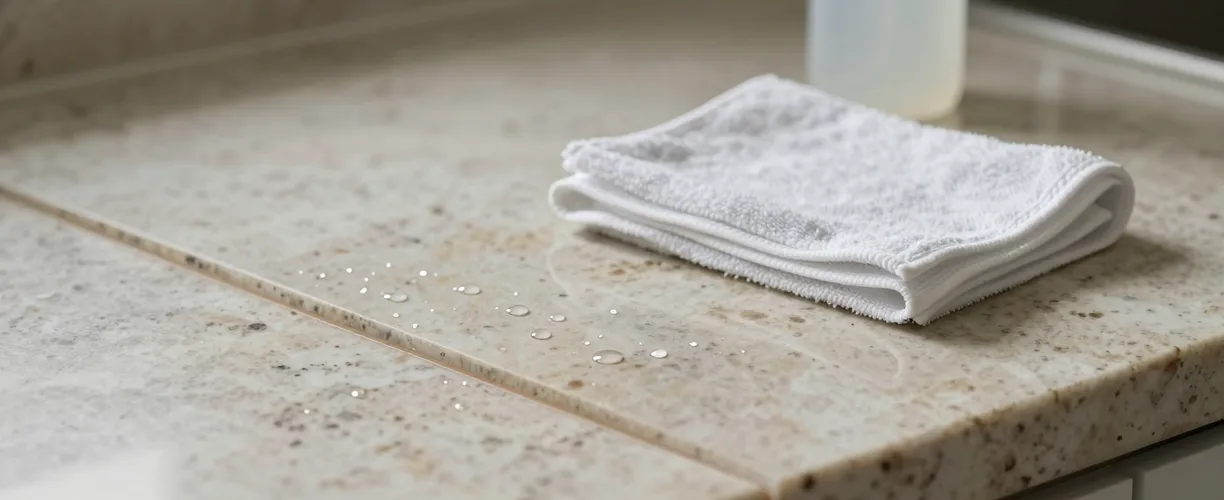
A natural stone worktop lasts for decades if you follow three simple rules: seal it periodically, avoid acidic and abrasive products and clean it daily with pH-neutral solutions. The rest are details. Granite is more forgiving, marble more sensitive to acids, but the principle is the same for both. Below we explain exactly what to do and, more importantly, what not to do, so you do not end up dulling the shine or leaving stains on an expensive stone.
Natural stone, however compact, has pores. Sealing applies an invisible layer that fills the pores and prevents liquids — oil, wine, coffee, water — from penetrating. Without it, an oil stain can seep into the stone and stay there.
A simple test: put a few drops of water on the worktop. If the water beads and stays on the surface, the sealing is good. If the stone darkens where you put the water (absorbs it), it is a sign it needs re-sealing.
The surface must be clean and completely dry, with no detergent residue. The specialised product is applied evenly, left to penetrate and the excess wiped off according to the manufacturer's instructions. It is not a complicated operation, but it must be done on a clean stone, otherwise you "seal" the dirt under the layer.
This is where most mistakes are made, and some leave permanent marks:
In short: if a product does not clearly say it is suitable for natural stone, do not use it on the worktop.
Use a chopping board when you cut — not directly on the stone (you protect both the knife and the shine). Put a trivet under very hot pots: granite withstands heat well, but repeated thermal shocks do no material any good. And with composite stone (quartz), a trivet is mandatory, because the resins in the composition do not tolerate direct heat.
If oil or coffee stained the stone before sealing, do not scrub aggressively — you risk spreading the stain and dulling the shine. For grease stains that have penetrated, there are special absorbent pastes (poultices) for natural stone, which "draw" the stain out of the pores overnight. They are applied, covered, left to act and then removed. It is a repair operation, not daily cleaning, and in difficult cases it is safer to ask a specialist for advice than to experiment with household solutions that can make things worse.
Maintaining natural stone is not hard, it is just a matter of habit: periodic sealing, mild pH-neutral products, no acids or abrasives, plus a quick reaction to spills. With these rules, a granite or marble worktop looks good even ten years on.
At the Depozitul de Marmură we recommend both the right stone and the correct maintenance for each sort. See our range of granite worktops and marble worktops, brought from direct import.
Already have a worktop and do not know how to look after it, or want a new one? Write to us and we will tell you exactly which products to use. Request a free quote or recommendation.
Tell us what you need done and how large the surface is. We give you a quote within 48 hours, including our own delivery to Brăila, Galați, Tulcea, Buzău and Vrancea. Or come to the depot in Cazasu and pick your slab by hand.