
In short: granite steps slip in winter because of the finish, not because of the stone. Polished granite grips well when dry and turns slippery as soon as it gets wet; with ice it is worse still. Outdoors you want a rough finish — flamed or bush-hammered —, a slight fall on each tread so water does not sit, and in winter snow cleared quickly, with sand instead of salt. If your steps are already polished, they can be made safer without being taken out — with anti-slip strips or rubber mats.
In this article
Because water fills the gap between the sole and a perfectly smooth surface, and the sole has nothing left to grip. Polished granite is exactly that kind of surface: smooth as glass.
The surprising part: when dry, polished granite is not slippery. In some dry measurements, polished granite has even come out grippier than the same granite flamed. That is why a polished step feels safe in summer, in the showroom or on installation day. But dry grip tells you nothing about wet grip — the two often move in opposite directions. The real test of an outdoor step is done with water on it.
Winter adds a second problem: water left on the tread freezes. On a film of ice every finish slips, however rough. Hence the two things a safe step depends on: the surface (it must grip the sole when wet) and the water (it must not stay on the tread).
For outdoor steps, flamed or bush-hammered. Both leave the stone rough, with a fine relief that breaks the water film and gives the sole something to catch on.
| Finish | How it is made and how it looks | On outdoor steps |
|---|---|---|
| Polished | ground to a mirror shine; the most intense colour | avoid on the walking surface; fine on risers and vertical elements |
| Flamed (non-slip granite) | passed under a flame; the face becomes grainy and matt, the colour slightly lighter | the usual choice for steps, terraces and paths |
| Bush-hammered | struck mechanically with a toothed hammer; deeper relief than flamed | very rough; good where there is a lot of water or a slope, somewhat harder to clean |
| Sandblasted | sand jet under pressure; fine, even roughness | good, with a more discreet look than flamed |
| Brushed | brushed after flaming; matt, pleasant to the touch | smoother than flamed; better suited to covered areas |
Two things to know before choosing. First: the finish changes the colour. The same black granite looks mirror-black when polished and matt dark grey when flamed, so ask to see a sample in the finish you are ordering, not just the polished stone in the showroom. Second: roughness holds dirt a little longer. A flamed step is washed with a brush and water, not just a mop.
The combination we see most often, and which looks good: flamed tread, polished riser. Nobody steps on the vertical face, so the shine can stay where it brings out the colour of the stone. We wrote about which stone lasts outdoors in our article on natural stone outdoors.
With a test, not by eye. Two methods appear most often on flooring data sheets, and it helps to recognise them when you are shown a figure.
An arm with a rubber slider is released and drags across the surface, dry or wetted. How much the surface slows it down is read as the pendulum test value (PTV). British safety guidance, which uses this test as its reference method, sorts results into three bands: 0–24 means a high slip risk, 25–35 a moderate risk, and 36 or more a low risk. For natural stone there is a European test standard that describes the same pendulum method.
These come from a German method in which a person wearing shoes walks on an oiled ramp that is tilted more and more until they slip. The angle at which they slip gives the class: R9 between 6 and 10 degrees, R10 between 10 and 19, R11 between 19 and 27, R12 between 27 and 35, R13 above 35 degrees. The trap: the scale starts at R9, not R1. R9 does not mean "very good"; it is the lowest band, and in the wet an R9 surface can be too slippery.
What to take from this: when you are told a stone is "non-slip", ask in which finish, and measured wet or dry. A dry figure does not help you with an outdoor staircase. And the bands above are guidance, not Romanian law — the Romanian rule is written differently, as shown below.
They ask for the result, not for a particular finish. The Romanian design code for civil buildings on safety in use, NP 068-02, says two things about outdoor ramps and stairs that apply directly to steps:
The same code gives the relation used to size steps so they are neither tiring nor a trip hazard: twice the riser height plus one tread depth should come to between 62 and 64 cm. For people who walk with difficulty, the riser is at most 16 cm and the tread at least 30 cm; the recommended pairs are 15 × 32 cm and 16 × 30 cm.
The code does not say "flamed", gives no pendulum value and no R class. It only says the stair must not be slippery when wet and water must not stay on it. A rough finish and a slight fall are the usual way of getting there.
The code is addressed to the design of civil buildings. For a house, your designer decides how it applies to your project; we quote it here as a common-sense reference, not as legal advice.
With a slight fall towards the front and edges that let the water drop off. A perfectly level tread holds water after every shower, and at night that water is ice.
You will find more about stone choices on our landscaping stone page.
The shovel first, then sand. The gentlest approach for the stone is to clear snow quickly, before it is trodden down and turns to ice, and to scatter sand, which gives grip with no chemistry at all.
Ordinary salt melts ice, but at a price. Chlorides enter the pores of the stone and of the joints with the water, and when it dries they crystallise and push from inside. Conservators who work with old stone warn that road salt and calcium chloride do most harm to porous stones such as marble and sandstone. Among chlorides, magnesium chloride is considered the least damaging.
Granite is on the good side of this story: it is a dense stone that takes in very little water — our product sheet for Absolute Black granite lists water absorption of 0.02–0.06% by mass. To be honest, we found no measurements made specifically on salted granite steps, so we will not promise that salt does nothing to it. The vulnerable part of a staircase, however, is not the slab but the joints and the bed beneath it. So the advice stays the same for granite: salt as rarely as possible, sand as needed, and a good wash with water in spring.
Two more habits that damage steps: breaking ice with a hatchet or a crowbar chips the edges, and a metal shovel dragged on its corner scratches polished risers. A plastic shovel and a stiff brush are enough.
They do not have to come out. The two handiest fixes take an afternoon and do not harm the stone: stick-on anti-slip strips and rubber step mats. We do not sell them — any DIY store does — but it is worth knowing how to fit them so they actually last.
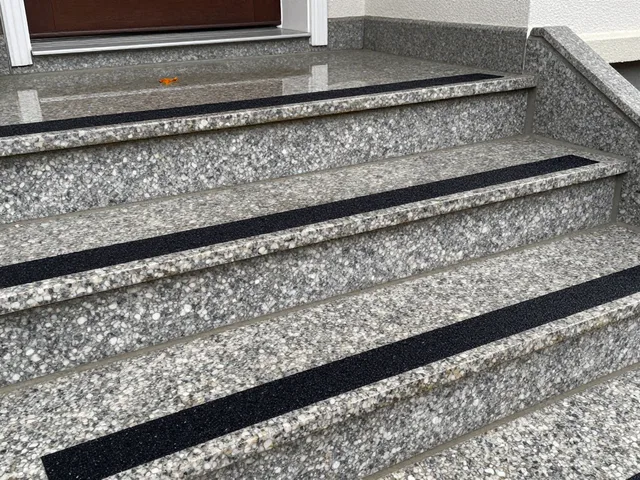
A tape with a rough surface, like coarse sandpaper, stuck along the tread near the edge — exactly where the foot lands on the way down. It does not change the stone: if you do not like the look, it peels off.
What decides whether it holds, according to manufacturers' fitting instructions: the stone must be clean, degreased and completely dry, and the surface at 4 °C or more when you apply it. So fit the strips in autumn, on a dry day, not on the first icy morning. After sticking, press them down firmly with a roller along the full length. On polished granite they bond directly; on rough or porous stone the same instructions ask for a primer first. Outdoors they wear with time, especially at the ends, and need replacing.
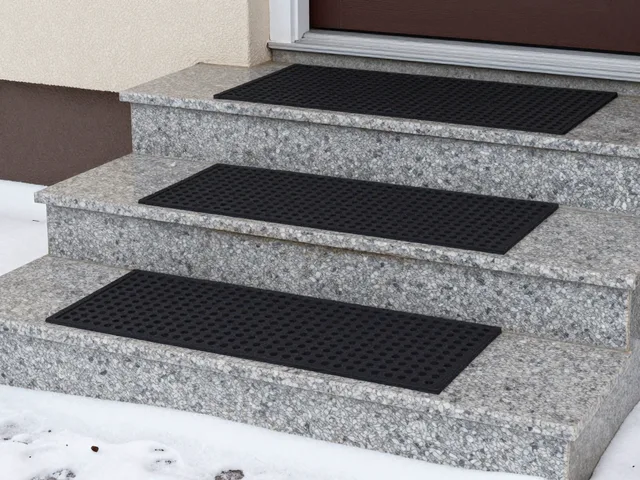
A heavy rubber mat with holes that let water drain through, laid on each tread. They are sold ready-made in step sizes — for example 25 × 75 cm or 30 × 100 cm.
Their advantage: nothing is glued to the stone. In spring you lift them and the steps look as they did on day one. Two things to watch: the mat should lie flat and not slide on the wet stone itself, and now and then you should lift it and sweep underneath, because water and grit collect under it.
If you want something permanent, there are three more routes, each with its limits:
For strips, mats and treatments we found no before-and-after measurements in the wet. If someone promises you a figure, ask to see it. Flaming, which is how the flamed finish is made in the workshop, is not a job to do on a staircase already installed next to a door and render.
With the details below we can answer first time:
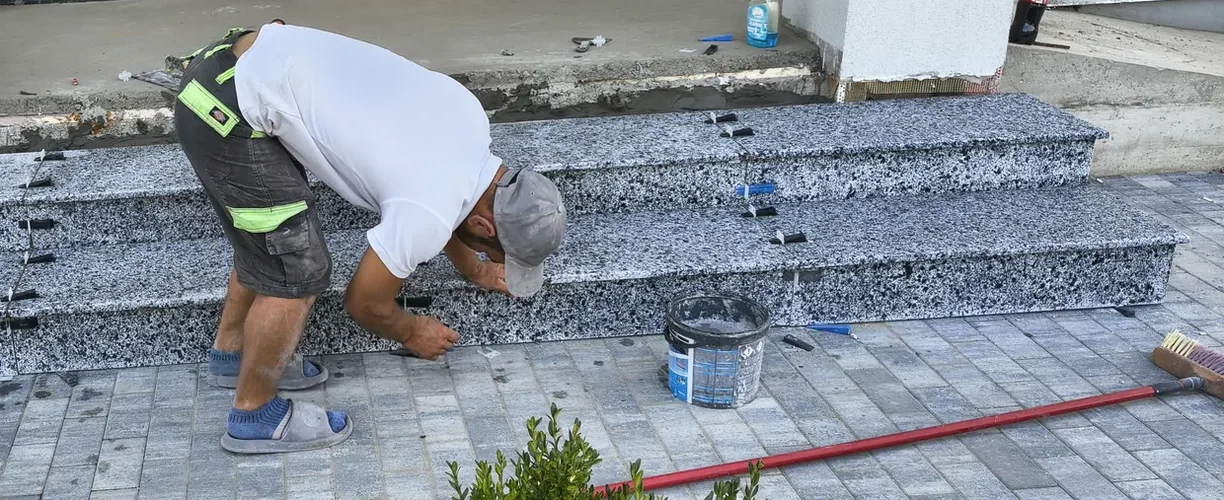
We cut the stone to size and deliver it; installation is done by partner teams, and we can put you in touch with them on request. The staircase in the photo above is grey granite, photographed during installation.
Far less than polished granite as long as it is only wet. On ice every stone slips, whatever the finish. That is why the fall of the tread and clearing snow before it freezes matter too.
Under a deep canopy the steps stay dry more of the time, but wind-blown snow and wet soles still get there. We recommend flamed on the walking surface and polished only on the risers.
Granite takes in very little water, so it is far less exposed than marble. Salt does attack the joints and the bed under the slabs, though. Use it rarely, prefer sand and wash the steps in spring.
Yes. Fastest, with anti-slip strips stuck near the edge or rubber mats laid on the treads. Permanently, with milled grooves or treatments that dull the polish; the latter change how the stone looks, so try them on a hidden area first.
It depends on the number of steps, the sizes, the stone and the finish, so we do not publish a fixed price. Send us the details above and you will receive a free quote within 48 hours.
Send us the stair measurements and a few photos, and we will reply with a quote within 48 hours. Ask for a free quote or visit our warehouse in Cazasu, Brăila, to see flamed granite next to polished and feel both with your hand. We take our time and never rush you.
Tell us what you need done and how large the surface is. We give you a quote within 48 hours, including our own delivery to Brăila, Galați, Tulcea, Buzău and Vrancea. Or come to the depot in Cazasu and pick your slab by hand.