
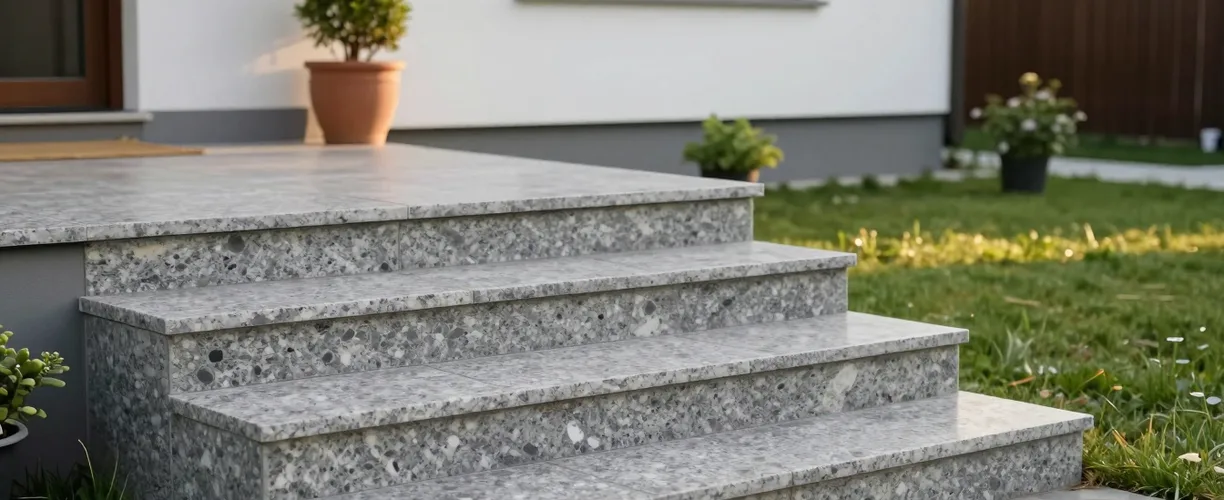
For outdoor use — paving, steps, terraces — the stone that holds up best is granite, and on surfaces you walk on it is chosen with a flamed, anti-slip finish. The reason comes down to two figures. First: water absorption. Granite absorbs between 0.1% and 0.6%, compared with marble, which can exceed 2%. The less water gets into the stone, the less there is to freeze in winter and crack it. Second: grip. A polished surface becomes dangerous when it rains or freezes, which is why outdoors you use a flamed finish, which leaves the stone slightly rough and grips the sole of the foot.
In concrete terms: polished marble looks spectacular, but outdoors it is a risky choice — it is porous, it stains and it is slippery in the rain. Flamed granite, on the other hand, withstands frost, traffic and water. Besides granite, in Romania andesite is also widely used for steps and outdoor cladding, likewise in a flamed finish. At our depot in Cazasu, Brăila, we work with stone imported directly precisely so we can cover these real outdoor requirements.
Stone with low water absorption holds up, and granite is at the top of the list. Dense granites are among the most frost-thaw-resistant natural stones, with absorption values below 0.4% for most varieties — well below the threshold at which cracking problems appear in frost.
Marble works the other way round: being more porous (over 2% in some types), it behaves like a sponge — it draws in water, and in winter the frozen water pushes from the inside and cracks the stone. Add to that its sensitivity to acid rain, which dulls the surface. That is why, for any surface permanently exposed outdoors, granite is the safe choice, and we keep marble for interiors or covered areas.
A flamed finish is essential wherever people walk because it provides grip — it prevents slipping. It is achieved by passing a flame over the surface, which finely "explodes" the minerals on the outside and leaves a slightly grainy texture. The result is a stone that does not turn into an ice rink in the rain or in black ice.
On steps, wet terraces, a pool edge or paths, a flamed finish is not a whim but a matter of safety. A polished granite step looks good in a photo, but becomes dangerous at the first frost. That is why manufacturers explicitly recommend a flamed finish for stairs exposed to the weather or areas with damp.
Besides flamed, outdoors you also come across:
The short rule: on horizontal surfaces and where there is water — flamed; on vertical and sheltered surfaces — you can go with brushed or polished.
Thickness is chosen according to where the stone sits and how much traffic it takes. For steps and cladding that is walked on, granite or andesite slabs are usually worked at around 2–3 cm, so they withstand knocks and heavy traffic. For vehicle paving or areas bearing weight, you go for greater thicknesses or cube-type setts, precisely so they do not give way under load.
At installation, two factors decide durability: the bedding (mortar or screed, with no voids beneath the slab where water could collect) and the joints, which must allow expansion and water drainage. A good stone installed badly still fails at the second or third frost. That is why, when we deliver slabs for outdoor use, we also discuss thickness with the customer, not just the pattern.
The choice is made by area, not in general:
See the range of steps and cladding for outdoor use and natural stone paving in the depot, so you can compare the materials on your project.
We do not recommend it on open terraces. Marble is porous and slippery when wet, and in frost it risks cracks. If you want the look of marble outdoors, a light-patterned granite in a flamed finish is safer.
Its fine texture catches a little more dust than polished, but it washes off easily with water and a brush. The trade-off is worth it: you gain safety when walking in any weather.
Very rarely, if it is dense granite installed correctly. The low absorption (under 0.4%) keeps it far from frost cracking. Most outdoor problems come from installation (water under the slab), not from the stone.
We are a depot with direct import of granite and marble, in Cazasu, Brăila county, and we deliver across Romania. Tell us where the stone will go — steps, terrace, path — and we will recommend the right material, finish and thickness, then make you a quote with what we have in stock and what we bring in to order. Ask us for a quote for your project.
Tell us what you have to do and how large the area is. We will give you a quote within 48 hours, including our own transport in Brăila, Galați, Tulcea, Buzău and Vrancea. Or come to the depot in Cazasu and pick the slab with your own hand.