
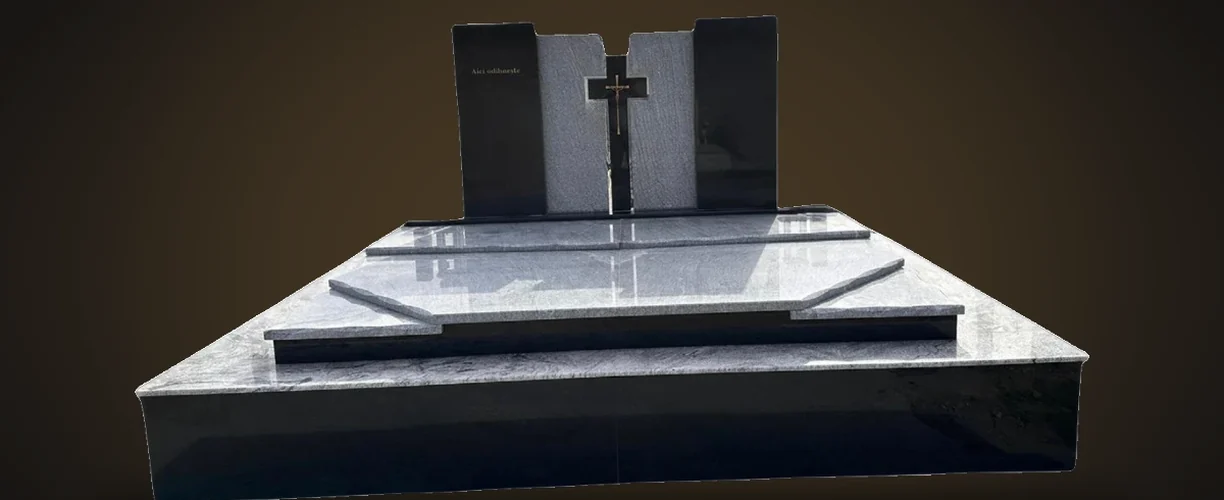
In short: the cover slab of a family tomb (a "cavou" in Romania) is made of granite, and the usual thickness is 3 cm; large covers go up to 4 cm. Ready-cut covers sold in Romania are about 2 metres long and 1 metre wide — most between 195 × 95 cm and 220 × 110 cm. The exact size, however, is not picked from a catalogue: it follows the burial plot and the cemetery's regulations, which may also cap how high the grave can be. For an accurate quote, send the plot measurements, the number of places, the stone, the finish and the text to engrave.
In this article
Three centimetres in most cases; four when the cover is large or spans a wide opening. Builders of tombs and shops selling ready-made covers say the same thing, independently.
Why does the extra centimetre matter? Because a cover's thickness is not about looks. The same technical guide explains it: the slab carries its own weight and sometimes the weight of people cleaning the grave or lighting a candle. Granite is rigid, not elastic — if the slab is too thin for the gap below it, or if the foundation settles unevenly, it cracks. A cracked cover is not repaired, it is replaced.
For comparison, our product sheet for Absolute Black granite lists usual industry thicknesses of 2–3 cm for slabs and 15 to 250 mm for monuments. A cover sits at the thin end of that range because it is a slab, not a block: it is held by the frame and the crypt walls, not by its own thickness.
Ready-cut covers are almost all around 2 × 1 metres. The most common sizes:
A standard cover works if it fits what you already have. For a new tomb or a renovation, though, the cover is cut to the tomb, not the other way round. The starting point is the inside of the crypt, plus the frame the cover rests on. As a guide, a crypt with 2 stacked places is typically 2.10–2.25 m long and 0.80–0.95 m wide inside; with 2 places side by side, the inner width grows to 1.60–1.80 m. The length stays almost the same, because the coffin sets it; the width grows with every place added side by side.
That is why, on double side-by-side tombs, the cover no longer looks like a "catalogue" cover: it is nearly as wide as it is long, or it is made of several pieces. All four tomb models in our catalogue are made to measure, from dimensions taken on site.
There is no national tomb size in Romania. Law 102/2014 on cemeteries requires the owner of each cemetery to have operating regulations, and plot sizes, permitted heights and approvals are set there. The differences between towns are large, as three regulations we read show:
| Regulation | Burial plot | What it limits for the tomb and cover |
|---|---|---|
| Timișoara (Local Council Decision 378/2020) | 2.50 × 1.30 m for one place with funerary works; 2.50 × 2.30 m for two | grave with cover at most 20 cm high; cross or headstone at most 1.8 m; works only with an approval |
| Galați (Local Council Decision 177/2024) | 2.5 × 1.5 m, but not less than 2.50 × 1.20 m | the tomb may rise at most 1 m above ground; kerbs at most 0.40 m high; cover slabs may be concrete or clad in marble or granite; approval required |
| Miroslava commune, Iași (Valea Adâncă cemetery regulations) | 2.50 × 1.20 m for one place; 2.50 × 2.40 m for two | two-place tomb: 2.65 × 2.45 m; works only with a work permit |
So the same two-place tomb can be 2.30 m wide in one town and 2.45 m in another, and the cover can be capped at 20 cm above ground or allowed up to a metre. The practical conclusion: ask the cemetery administration what sizes and height are allowed and check your concession deed before ordering the stone. Mind the outline too: work extending beyond the plot outline is not approved — neither the granite frame nor the foundation.
These are examples from public regulations, not a rule that applies everywhere. For your cemetery, only its own regulations and the administration's approval count.
The cover lies flat, outdoors, all year: rainwater sits on it, then freezes. It is the hardest-working part of the whole grave, and granite is the stone that holds up there.
Our Absolute Black granite sheet lists water absorption of 0.02–0.06% by mass and describes it as weather- and frost-resistant: the stone hardly takes in water, so there is nothing inside to freeze. Marble, by contrast, is a carbonate rock, and studies on marble protection show that outdoor marble and other carbonate rocks are particularly vulnerable to acid rain. On a cover, that means lost polish and stains, sooner than on an upright cross. We wrote more about the difference in our article on stone for funeral monuments.
Colour is a matter of taste. Uniform black gives the best contrast for engraving; finely speckled greys such as Steel Grey hide dust and water marks better; reddish and brown granites appear on two of the tombs in our catalogue. The cover can also be a different stone from the cross or frame — the model in the photo above combines grey and black granite.
Polished, most of the time — it is the finish that brings out the colour of the stone and shows lettering best. All the tombs in our catalogue are polished.
Polished granite has one drawback worth weighing on a cover: it is slippery when wet. That is why polished stone is considered a mistake on outdoor stairs, and flamed granite is used as a non-slip finish. A tomb cover is not a staircase, but if you know people will step on it — to clean, to light candles, to lay flowers — you can ask for a flamed or brushed finish on the whole cover or just part of it, with a polished area for the engraving. This is agreed when ordering, because the finish is done in the workshop, not at the cemetery.
A tomb cover is not put in place just once. At every new burial it is lifted and put back — the Timișoara cemetery regulations even list "lifting and refitting the cover on existing funerary structures" among the services the cemetery provides.
A 2 × 1 metre granite cover is heavy, and on double side-by-side tombs it gets even bigger. That is why some families order it in two pieces, which are easier to lift. The downside: the joint between the pieces is visible and has to be sealed. Tell us from the start how you want the tomb to open, so the pieces and any holes for lifting rings are cut in the workshop.
The price of a tomb cover cannot be given "remotely" without measurements: it depends on size, thickness, stone and how much engraving there is. With the list below we can answer first time, without ten messages back and forth.
A few photos of the plot, taken from the front and the side, help more than any description. Measure between the real edges of the plot, not between neighbouring graves. We cut and deliver the stone; installation is done by partner teams, and we can put you in touch with them on request.
3 cm is enough for an ordinary single-place cover. For large covers, double side-by-side tombs, or where people often step on the cover, 4 cm gives extra safety against cracking. Send us the dimensions and we will recommend the right thickness.
Usually yes, and some regulations say so explicitly — Galați allows cover slabs clad in marble or granite. Any change to an existing tomb must, however, be reported to the cemetery administration, which decides whether an approval is needed.
The regulations we read require an approval or work permit for funerary works, including tombs and covers. The approval is issued by the cemetery administration; ask before ordering.
It depends on size, thickness, stone, finish and engraving, so we do not publish a fixed price. Send us the details above and you will receive a free quote within 48 hours.
Send us the plot measurements and a few photos, and we will reply with a quote within 48 hours. Ask for a free quote or visit our warehouse in Cazasu, Brăila, to see the granite in person. We take our time and never rush you.
Tell us what you need done and how large the surface is. We give you a quote within 48 hours, including our own delivery to Brăila, Galați, Tulcea, Buzău and Vrancea. Or come to the depot in Cazasu and pick your slab by hand.