
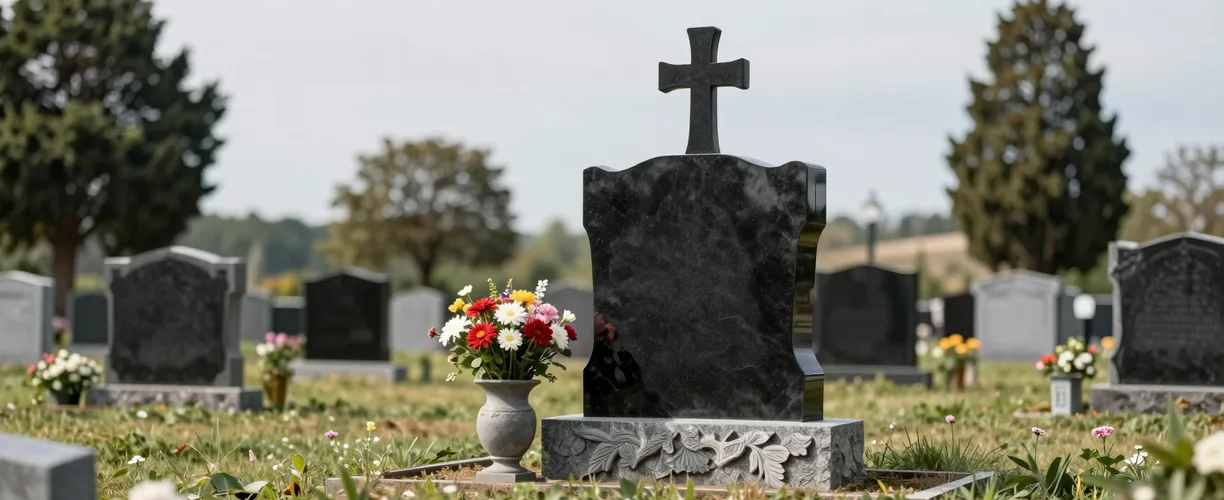
For a funeral monument, the stone used almost everywhere is granite, and the most requested shade is black granite. The reason is simple and measurable: granite absorbs very little water — under 0.4% by the ASTM C97 standard, compared to 0.5–2% for marble — and withstands well the freeze-thaw cycles that, over time, break porous stones. A monument stands outdoors for 30, 50, 100 years, exposed non-stop to rain, frost and sun. Granite is dense, hard and does not fade, so the engraved lettering and photograph stay clear for a long time.
Marble is beautiful and cheaper on some models, but it is more porous: it absorbs water, catches black deposits from pollution and, over the years, the edges of the letters round off and fade. That is why marble is used more often indoors or for decorative elements, while granite remains the base material for the vertical slab and the plinth of a monument. In our depot in Cazasu, Brăila, we work with the monument slabs directly in the depot, where absolute black can be compared with Impala side by side.
Engraving holds up best on dense, dark granite, and the modern method — laser engraving or photo-engraving — gives a precise outline that does not wear off. The laser controls the depth and intensity, so the text and portrait come out uniform and stay clear for many years, because granite does not erode quickly.
There is also deep manual engraving, followed by painting (gold or silver). Here maintenance matters: the paint can be refreshed every few years, but the outline carved into the granite remains. On marble, the same letter fades faster, because the stone itself gives way at the edges. The conclusion for anyone ordering: a black granite base plus laser engraving is the combination that looks good even decades later.
The polished finish is the standard for monuments because it closes the surface pores and brings out the deep black. A polished surface is easy to clean: water and a soft cloth, without acidic or abrasive solutions, which could attack the shine over time. No complicated treatments are needed — granite, through its low absorption, largely protects itself.
For the plinth or the horizontal elements, some workshops choose a matt or flamed finish, less slippery and which does not show fingerprints. The choice of finish is a matter of taste and of where the monument is located, but the material stays the same: dense granite, with low absorption.
It can, but we do not recommend it for the exposed inscribed slab. Marble, being more porous, stains and lets the engraving fade faster outdoors. It is more suited to decorative accents or indoor work.
Not significantly. Granite is admired precisely for its resistance to fading; the colour comes from the minerals in the body of the stone, not from a surface layer.
It depends on the model and the workshop carrying out the work. We supply granite slabs to the dimensions required by each project — from the vertical slab to the plinth and the border elements.
We are a depot with direct import of granite and marble, in Cazasu, Brăila County, and we deliver throughout Romania. If you are preparing a funeral monument and want black granite to your dimensions, ask us for a quote with the type of granite, the dimensions and the desired finish — we will tell you what we have in stock and what we bring to order. Contact us for a personalised quote.
Tell us what you need done and how large the surface is. We give you a quote within 48 hours, including our own delivery to Brăila, Galați, Tulcea, Buzău and Vrancea. Or come to the depot in Cazasu and pick your slab by hand.