
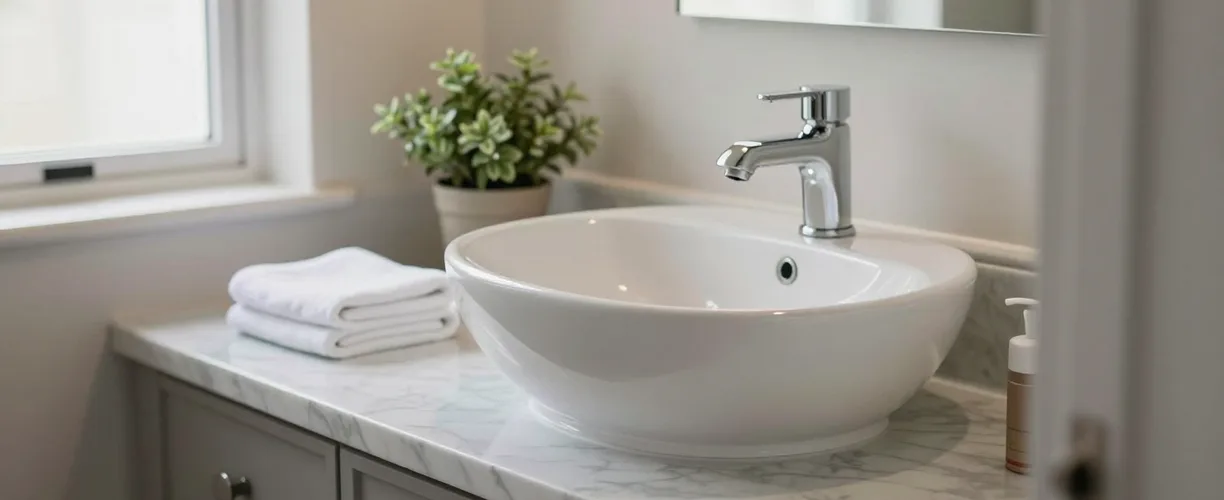
In short: for a bathroom used daily, granite is the safer choice, while marble is the choice for effect, but more demanding. The difference comes from the structure of the stone. Granite is less porous and resists water and stains better, so it needs less care. Marble is more porous and sensitive to acids, so it looks spectacular, but needs regular sealing and mild products to keep its shine. The rest of the article explains what to base your choice on, depending on how you use the bathroom.
In a bathroom, water is everywhere: on the washbasin top, on the sills, on the floor. Here porosity matters.
This does not mean marble has no place in a bathroom — it only means it must be properly protected and wiped dry more often.
Stains in a bathroom come from cosmetics, soaps, perfumes, oils and cleaning products. Marble, being porous and sensitive to acids, can pick up stains or matt patches if an acidic product (many cleaning solutions, but also perfume or nail polish) is left on it. Granite, with its non-porous surface, prevents liquids from being absorbed and is more forgiving of everyday spills.
An important detail: marble can etch matt on contact with acids — that is, the shine disappears locally, even if the stone has not been coloured. It is a chemical reaction, not dirt, and that is why the choice of cleaning products matters enormously.
This is the biggest practical difference between the two:
Marble remains the preferred choice where you want a luxurious look: a washbasin with fine veining, a clad wall, a vanity area that draws the eye. If the bathroom is not used intensively (a guest bathroom, for example) or you are willing to maintain it carefully, marble offers an effect that granite, more sober, does not always give.
For a family bathroom, used every morning by everyone, granite saves you a lot of hassle.
Yes, more than you think. The same stone can be polished (glossy, elegant-looking, but more slippery when wet) or brushed/matt (a velvety look, less slippery and more forgiving of water marks and fingerprints). In a bathroom, a matt or brushed finish on the floor and shower steps reduces the risk of slipping, while a polished washbasin top stays easy to wipe. It is worth discussing the finish separately for each surface — not everything needs to have the same shine.
Ask yourself three simple things:
Whatever the choice, sealing at installation is not optional in a bathroom. It creates the layer that repels water and stains and extends the life of the stone.
At the Depozitul de Marmură we bring the stone from direct import, so you can see and touch the actual slabs before deciding. Explore the range of granite bathroom worktops, the marble worktops options and the window sills from the same stone, so everything matches.
Granite wins on durability and convenience; marble wins on looks, but requires care. There is no universal answer — there is the right answer for your bathroom, depending on how much you use it and how much you want to look after it.
Tell us what your bathroom looks like and how you use it, and we will recommend the right stone and make you a quote. Request a free quote or drop by our depot in Cazasu, Brăila, to see the slabs in person.
Tell us what you need done and how large the surface is. We give you a quote within 48 hours, including our own delivery to Brăila, Galați, Tulcea, Buzău and Vrancea. Or come to the depot in Cazasu and pick your slab by hand.