
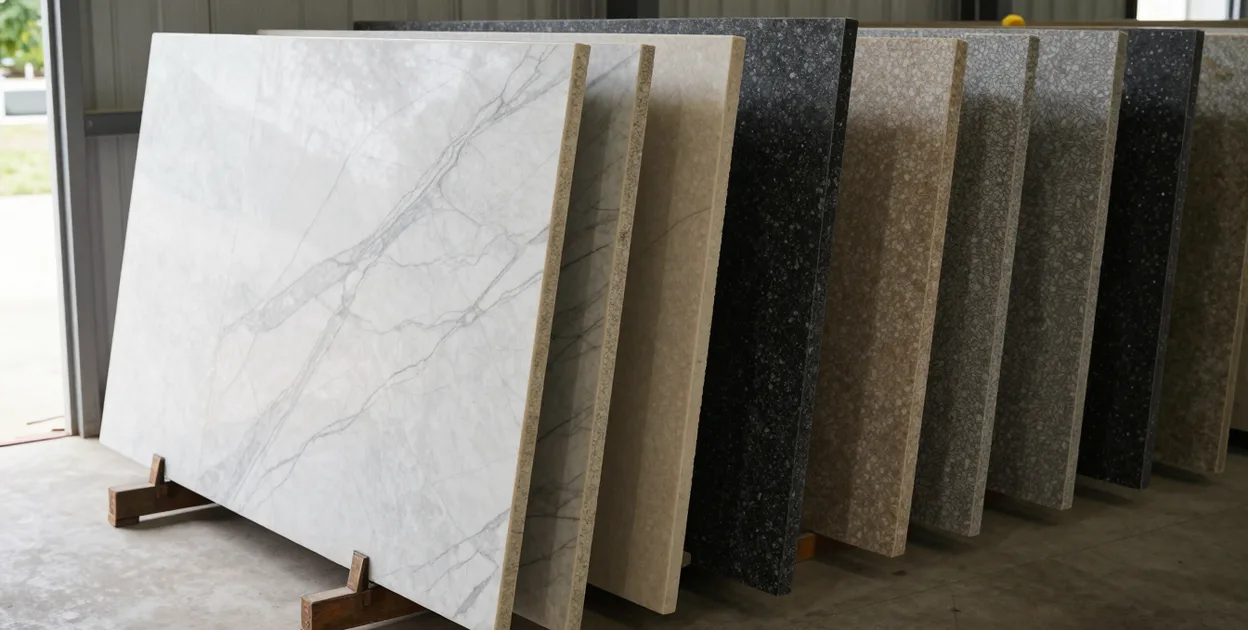
How do you choose the right natural stone? In short: you start from where the stone will sit and how hard it will be used, not from how it looks in a photo. For heavily used work surfaces, outdoors or funeral monuments, choose granite — it is hard (6–7 on the Mohs scale), almost non-absorbent (around 0.01% water absorption) and resists scratches, heat and stains. For areas where you want elegance and traffic is low — window sills, bathrooms, decorative floors — you can choose marble, which is softer (3–4 Mohs) and more porous, therefore more sensitive to acids and stains, but with a look that is hard to match.
Once you have chosen the type of stone, you still have four decisions: the finish (polished, brushed or flamed), maintenance and sealing, the colour and the budget. In the article below we take them one by one, in the language of someone who is not a specialist, so you can ask the depot for exactly what you need and not pay for what does not suit you. We are PROPIATRA DISTRIBUȚIE (Depozitul de Marmură), we import directly from India, Brazil, Turkey, China and Egypt, and we work with over 300 companies in construction and the funeral sector.
This is the first question and the one that settles half the decision. The difference is not "which is better", but "which suits what you are doing". The two stones behave completely differently to wear, water and acidic substances.
Granite is a volcanic rock, dense and very hard. On the Mohs scale it sits at 6–7, and its water absorption is almost zero, which makes it practically impermeable. In practice, this means it withstands a knife, a hot pot placed directly on it and liquids that would stain other materials. We recommend it for:
Marble is a softer and more porous rock. It is sensitive to acids — a slice of lemon, vinegar or an aggressive detergent can leave matt marks if the surface is not protected. It is not a flaw, it is the nature of the stone. That is why marble shines best where it is admired visually and less exposed to abuse: window sills, fireplace surrounds, decorative indoor floors and cladding, elegant bathrooms. With proper sealing and careful upkeep, it keeps its beauty for many years.
The choice is made by purpose. Here is how we think about it, in concrete cases:
The finish completely changes the look and behaviour of the same slab. There are three common options:
The simple rule: polished for beauty and indoors, flamed for safety and outdoors, brushed when you want something in between.
Both types of stone need common-sense care, only marble is more demanding. A few rules that keep the stone beautiful for years:
As for durability: granite, well fitted and sealed, can last practically a lifetime; marble, with proper maintenance, keeps its elegance for a long time.
Colour is not just taste — it influences how the space looks and how visible marks are. A few pointers:
It is important to remember: natural stone is not manufactured, it is quarried. Every slab has its own design, its own veins and shades — two slabs from the same block will never be identical. That is its beauty, but it also means it is worth seeing the actual slab before deciding, especially on large projects where you want the pieces to match. At the depot you can choose the very slab you buy.
The price depends on the type of stone, the rarity of the colour, the finish, the thickness and the processing (cutting, edge polishing, cut-outs). As a rule, rare marble is more expensive than a common granite, but the variations are large — which is why we do not put fixed prices in an article, but make you a quote for your own project.
To receive a proper and quick quote, tell us from the start:
With this information we recommend the right stone, tell you what is in stock from our direct import and give you a real price, with no surprises.
There is no "best stone" in general — there is the right stone for what you have to do. Granite for durability (worktops, steps, outdoors, monuments), marble for elegance in gentle areas, a finish chosen by location, timely sealing and a colour that suits the space. If you remember only this much, you have already made a good decision.
Ask us for a free quote for your project — we reply with the right stone and the real price. Or come directly to our depot in Cazasu, Brăila County, to see and touch the slabs: we import directly from India, Brazil, Turkey, China and Egypt, we have stock for construction and the funeral sector, and we help you choose the very slab you take home.
Tell us what you need done and how large the surface is. We give you a quote within 48 hours, including our own delivery to Brăila, Galați, Tulcea, Buzău and Vrancea. Or come to the depot in Cazasu and pick your slab by hand.